
Checking Criminal History in Bancroft
A useful Bancroft criminal record check starts by naming the document sought. A Bancroft incident narrative stays with the agency that wrote it. A booking file belongs to the Kossuth County Jail. A charge, plea, disposition, or sentence belongs to the Clerk of Iowa District Court. The Iowa Department of Public Safety, Division of Criminal Investigation, holds a different Bancroft record product: releasable Iowa history tied to qualifying fingerprints and reported outcomes. Those Bancroft sources may update at different times.
Use the shortest official route first, then move outward only when the question changes:
- Call Bancroft Police and City Hall at 515-885-2382 to identify who handled the event.
- Ask for an existing police report by date, location, party, incident type, and report number if known.
- Call Kossuth County Jail at 515-295-9277 for current custody, bond, or release information.
- Search Iowa Courts Online for a filed public case, or ask the Kossuth Clerk about court documents.
- Use the official Iowa DCI record-check channel for releasable fingerprint-backed statewide history.
Bancroft Complaint or Police Record
Bancroft offers a nuisance complaint form, but that form starts a new complaint. It does not retrieve a report that already exists. This Bancroft distinction matters when a person wants to understand a past police contact. The request should state that it concerns an existing Bancroft Police incident record and should not be framed as a new nuisance report. Bancroft staff can then decide whether Bancroft Police, the Kossuth County Sheriff, or another agency created the document.
The official Bancroft Police page explains that the nuisance form may be returned by mail, fax, the secure outdoor drop box, or at the counter. Those are Bancroft form-submission choices, not a published menu for police-record delivery. No separate Bancroft police records email, copy portal, base fee, or firm processing time was documented. Call first, describe the existing record, and ask which submission method applies and whether Bancroft staff can provide a cost estimate.
Bancroft Police Department Records
Bancroft Police and City Hall share 105 E. Ramsey Street, a mailing address at PO Box 157, and the published 515-885-2382 number. Chief Art Ingalls leads the Bancroft Police Department. Bancroft city hours are weekdays from 8 a.m. to 4 p.m. The shared counter makes a call or visit the practical local starting point, but it does not make every Bancroft document a police record. The legal custodian still depends on which office created and keeps the item.
For an incident request, give a date or range, the location, a named party when appropriate, the event type, and any report number. Ask whether Bancroft Police handled the event. Also ask what part can be inspected or copied. An active investigation, juvenile information, victim details, or protected identifiers may limit release. A denial or redaction does not prove the report is absent.
The manifest image comes from the Bancroft Police source page.
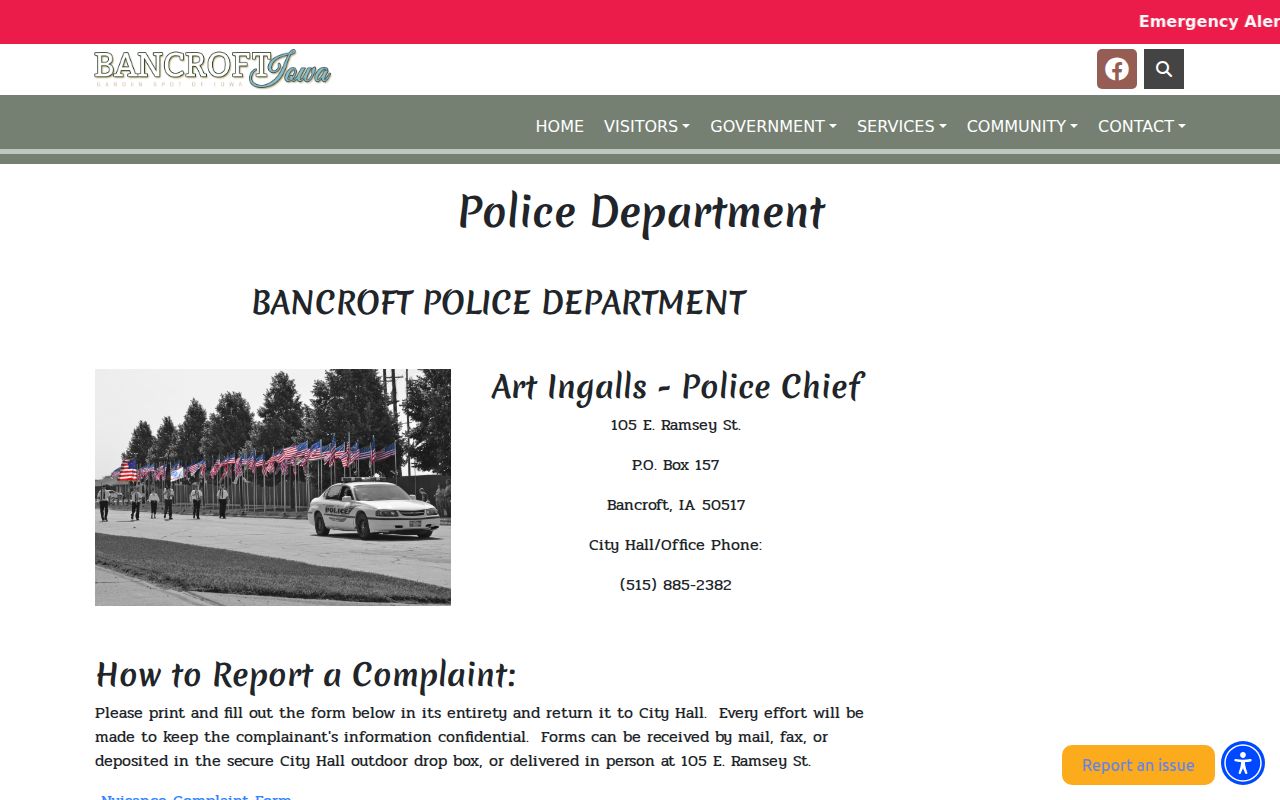
The source view reinforces that Bancroft relies on direct police and city contact rather than a separate online criminal-record portal.
Four Bancroft Record Request Routes
Phone and counter contact are the verified starting points for an existing Bancroft police record. Bancroft also publishes a fax number, 515-885-2383, and a post office box. A requester should not assume every channel used for the nuisance form automatically applies to Bancroft police copies. Ask staff to confirm how a Bancroft record request should arrive. The lack of a dedicated online form makes a clear description more important.
Bancroft Police and City Hall
105 E. Ramsey Street
PO Box 157
Bancroft, Iowa
515-885-2382
Fax: 515-885-2383
Weekdays, 8 a.m. to 4 p.m.
The official Bancroft administration page is the source for City Hall access details.
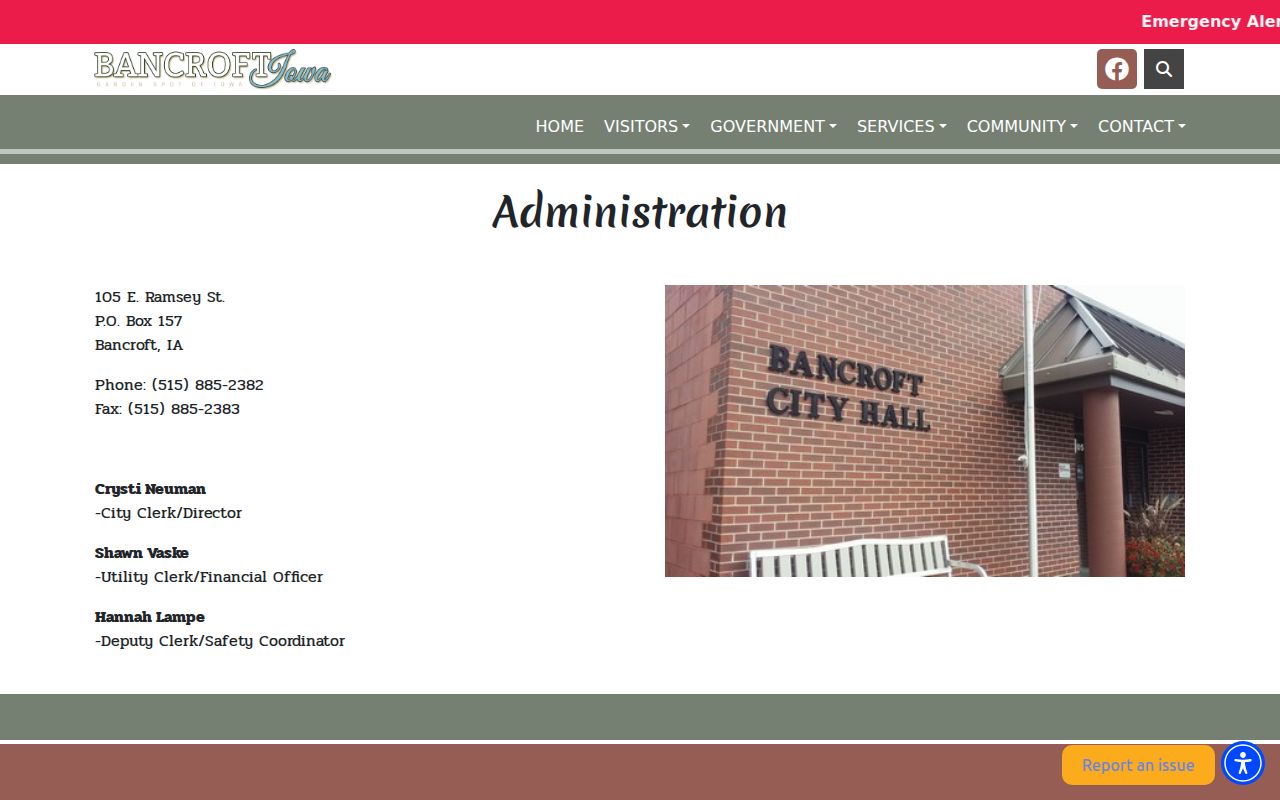
This city-centered contact point is useful for routing, while jail and court records remain with Kossuth County offices in Algona.
Bancroft Arrests and Bookings
Bancroft has no published city jail roster, arrest blotter, or booking database. When Bancroft Police makes an arrest, its officer narrative remains a city police record. Custody then routes to Kossuth County Jail. Jail staff hold the booking, intake charge, bond, property, housing, release, and transfer information. For current custody, call 515-295-9277. The county jail page also routes users to VINE for custody status and notifications.
A Bancroft jail intake charge is not a court finding. The Kossuth County Attorney decides what Bancroft charge to file, and that filed matter appears in Iowa District Court if it is public. Iowa Courts Online ordinarily becomes the better source once a Bancroft case exists. The broader Kossuth County arrest lookup explains the county custody channels in more depth.
Note: An arrest records an accusation and custody event; it does not prove that Bancroft charges led to a conviction.
Bancroft I-CRIME Trend Records
Iowa I-CRIME answers a statistics question, not a named-person history question. In the Annual Trend Report, choose Bancroft Police Department under Agency. Then preserve the offense choice, years, reporting dimension, and export date. Iowa DPS notes that incident-based submissions can be corrected, so a chart viewed later may not match an earlier export. A person should never treat an agency trend total as proof about one case.
The Bancroft report can include several kinds of incident-based information and may count more than one offense within an event. It is also different from a Bancroft court docket, which follows a filed case, and from DCI history, which is identity-centered. The I-CRIME Annual Trend source supplied the assigned portal image.
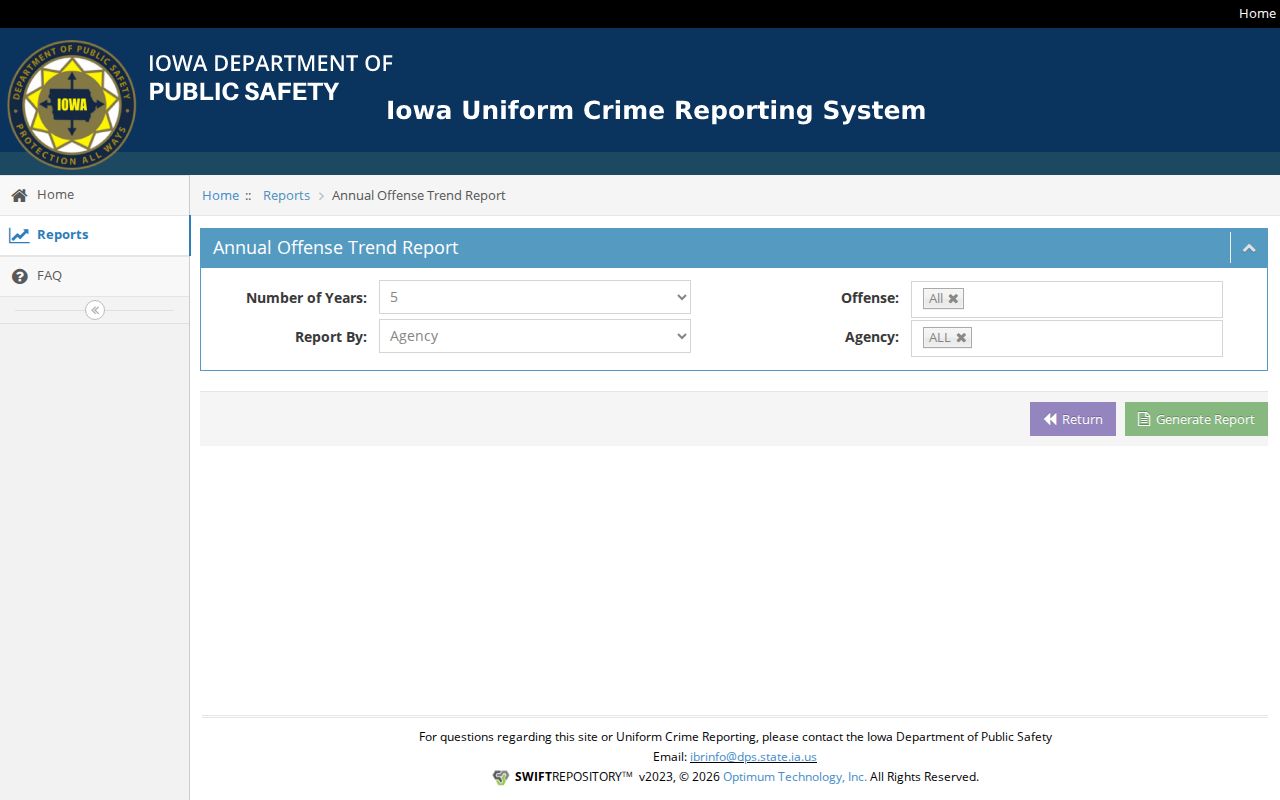
The portal is best used as dated Bancroft public-safety context, with all filters recorded beside any result.
Municipal Court Records in Bancroft
Bancroft does not operate a municipal criminal court. Iowa’s 1973 Unified Trial Court Act abolished the former municipal, mayor’s, police, and justice-of-the-peace courts. Criminal matters and city-ordinance cases now proceed within Iowa’s unified District Court system. City Hall may accept a traffic payment as a convenience, but that does not make City Hall the court custodian or create a Bancroft municipal docket.
For a certified disposition or a case history, search Iowa Courts Online and contact the Kossuth County Clerk of District Court at 114 W. State Street, Suite 10, third floor, Algona, 515-295-3240. Public online fields may include the case type, parties, charges, filed events, outcome, bond, and financial obligations.
| Court Name | Iowa District Court for Kossuth County, Judicial District 3A |
|---|---|
| Case Types Heard | Criminal charges, traffic matters, and city-ordinance cases assigned within the unified court |
| Case Lookup Channel | Iowa Courts Online, courthouse public terminal, or Kossuth Clerk |
| What the Docket Shows | Parties, filings, charges, dispositions, bonds, and financial entries when public |
| Copies & Fees | Ask the Kossuth Clerk for availability and an estimate; no local criminal-copy schedule was found |
Bancroft Traffic Payments Aren't Court Files
Bancroft’s traffic-payment option can trip up a records search. Payment is a transaction channel. Court custody is a legal records function. A person who paid at Bancroft City Hall may still need the Kossuth Clerk for the charge, judgment, or certified disposition. The Bancroft counter should not be treated as a second court merely because it accepts money tied to a citation.
Iowa Courts Online uses case types such as FECR, AGCR, SRCR, and SMCR for broad classes of District Court cases. A Bancroft docket can show allegations and later outcomes, including dismissal. That makes it more useful than a payment receipt when someone is reviewing what a Bancroft citation became. If the Bancroft online record is missing detail, a courthouse terminal may expose public links unavailable in the free view, and pre-1998 or nondigitized material may require direct Clerk contact.
Where Bancroft Records Go
One Bancroft event can produce several records. Police create the report. Kossuth County Jail creates a booking file if custody occurs. The prosecutor and Kossuth Clerk create the court case if charges are filed. Courts and corrections agencies then report qualifying outcomes to DCI, where they connect to a fingerprint-backed arrest cycle. A missing fingerprint or delayed disposition can cause official systems to differ for a time.
Record flow: Bancroft Police › Kossuth County Jail and Iowa District Court › Iowa Department of Public Safety, Division of Criminal Investigation
For a recent Bancroft event, ask Police and the jail first. For filed Bancroft charges, use Iowa Courts Online. For releasable statewide identity history, use DCI. A “no history” response from one Bancroft source does not certify that the other sources contain nothing. It may reflect record scope, timing, confidentiality, or Iowa dissemination limits.
Bancroft Records and Countywide 911
Bancroft participates in Kossuth County’s shared emergency communications system. A February 2025 Joint 911 agenda documented radio training for Bancroft and other county communities, along with equipment and battery work. That local network helps explain why the first question for a report request is who handled the call. A Bancroft location does not by itself prove Bancroft Police wrote every related record.
The official training item is operational context, not an arrest total. Likewise, Bancroft’s DirectTV scam-prevention notice documents a public-safety response, but it does not identify a person’s criminal history or prove that charges followed. These city facts help a requester ask better questions: give the address, date, and event type, then let the custodian confirm whether Police, Sheriff, or another agency holds the report.
Public Access Rules in Bancroft
Iowa law begins with public access, but it does not make every Bancroft police record fully open. The custodian may protect active-investigation material, juvenile information, victim details, personal identifiers, and records made confidential by another law or court order. Public portions may be separated from protected content. For an existing city report, ask Bancroft staff what can be inspected or copied and request the basis for any denial.
The county’s public-record policy is a useful Chapter 22 model when a Bancroft record has moved to Sheriff custody. It permits oral or written Bancroft requests and does not require the suggested form. It also explains estimates, redaction, and the rule that an office need not create a new analysis or nonexistent format.
Key Statutes:
Iowa Open Records Law, chapter 22 gives every person access to public records unless another law makes them confidential.
Iowa Code § 692.2 governs DCI dissemination and limits some nonconviction information.
Iowa Code § 692.5 lets a subject or attorney inspect and challenge inaccurate or unauthorized criminal-history data.
Bancroft Records Cross City Lines
Bancroft calls itself the “Garden Spot of Iowa,” and its joint fire department dates to 1944. That history reflects services built across local boundaries. Modern criminal records cross boundaries too, but in a fixed legal chain. The compact Bancroft Police and City Hall arrangement keeps local report access close. County booking and court functions remain in Algona, while statewide history sits with DCI.
Keep those boundaries visible during a search. A police report describes the investigated event and officer work. A booking record documents custody. A court file documents prosecution and outcome. DCI releases the part of a fingerprint-backed Iowa history allowed for that requester. Combining those labels into one “Bancroft criminal record” can hide who controls corrections, copies, and access decisions. Using the proper office also reduces the risk of relying on a stale result.